Investigate
- What you call success
- What you believe you need
- What you compare yourself against
- What you were taught to value
The Yogic Blueprint
Look beyond the endless pursuit of achievement and turn attention inward to discover clarity, steadiness, and a deeper kind of fulfillment.
We have become remarkably capable at shaping the world around us. We build cities, create technologies, cross continents in hours, and carry access to almost unlimited information in our pockets. Yet for all this outward intelligence, a simple question remains: have we learned how to be inwardly fulfilled?
Modern society is built on a belief that successful life is confined to external achievements. We look up to the wealthy and down to the poor. In the promise of fulfillment, we seek, chase, build, accumulate, and strive.
This is natural because all of us have a deep desire for security and happiness. We try to find it one form or another. In this way, the mind is always looking for something that might provide long-lasting peace and joy.
However, there is a catch.
You see, what modern culture calls personal fulfillment is mostly a temporary fix for deeper longing. We achieve something, enjoy it for a while, and soon the mind begins searching again. This is why some of us cannot help but wonder whether there is more to life than what meets the eye. Something beyond the everyday hustle, the endless pursuit, and the dopamine loop.

I invite you to investigate.
This investigation is a practical example of Mind-Yoga. Rather than immediately accepting what the mind desires, believes, or pursues, we turn attention toward the mind itself and ask: why does it move this way?
When you look closely within, you will come to realize that human desires are influenced by the society we live in. Country and culture shape the mind. Each culture gives the mind a different image of what is valuable, respectable, shameful, desirable, and forbidden.
As a result, most people do not actively question their worldview because their worldview is part of their mental structure. But what feels natural is often only what has been repeated long enough to feel like truth.
Your worldview is part of your mental programming.
Mind-Yoga asks you to observe this programming rather than blindly live from it. What do I actually want, and what have I been programmed to want? What do I truly value, and what has society taught me to value?
When left unconscious, desire has a way of distorting our sense of what we truly need. Even a king is rarely satisfied with his borders. He always wants to expand, just a little more. You may not be a king or a queen, but the same movement lives within ordinary life too: the desire to have more, become more, and to finally feel complete.
The problem is not desire itself. The problem begins when we expect the next achievement to resolve an inner sense of incompleteness.
The mind can turn “enough” into a horizon that keeps moving.
Across history, many philosophical and spiritual traditions have approached human potential differently from modern consumer culture. Material abundance was often understood as only one dimension of life, while self-knowledge, wisdom, virtue, liberation, or spiritual realization represented another.
But over the centuries, industrialization and technological progress changed our priorities. In many ways, this has been an extraordinary success. But it has a hidden cost. Comfort and success have become more important than inner understanding.
We have become highly educated in how to manipulate the material world, yet comparatively little attention is given to understanding the movement of thought, emotion, desire, fear, and identity within ourselves.
In fact, the meditative way of living is so distant that most people never discover the clarity and strength available through simply learning how to observe their own mind.
The more one forgets the inner dimension of being, the more one seeks in the outer world. Success and pleasure become substitutes for peace, love, and understanding. Yet no matter how much is gained, a sense of lack lingers beneath it all.
We learned how to transform the world around us, while barely learning how to understand the world within.
Mind-Yoga is interested precisely in this movement. Why does the mind keep searching? What does it expect the next achievement, relationship, possession, or experience to finally give it?
That is why material success by itself cannot guarantee inner peace. Money is useful. Comfort is fantastic. Pleasure has its place in our lives. There is no need to reject any of them. But without inner peace, none of it can complete the human being.
We can see this even among people who appear to have everything; the search for fulfillment, peace, and happiness continues. Yes, survival and money are important to cover. But once these needs are reasonably met, another dimension of life often begins to reveal itself.
For the spiritually inclined, nothing external can fully quench the thirst to know yourself.
Joy that depends on outer success never quite fills the cup.
The outer world offers a sip, but the deeper source of fulfillment must also be discovered within.
Looking back through history, we find that many cultures understood material abundance as only part of the human picture. Human beings have repeatedly searched for something beyond comfort, survival, and wealth.
Once the immediate struggle of life begins to quiet down, deeper questions naturally arise: “Who am I?” “What is the meaning of life?” “Is there something more?”
These questions mark a shift in attention. Instead of asking only what we can acquire from life, we begin asking what life itself is, who is experiencing it, and whether the mind can know itself directly.

At some point, the question changes from “What more can I get?” to “What is all of this?”
At that moment, when we begin to wonder whether there is a deeper meaning to life, we naturally turn toward spirituality. We want to know what lies beyond ordinary experience and whether life holds possibilities we have not yet discovered.
We do not simply want to live, struggle, and survive. We want to experience life fully and feel deeply fulfilled. This is why in many cultures, the ultimate aspiration has been awakening: inner freedom and the realization of higher truth.
Out of this desire to know life more deeply, many contemplative traditions arose. Yogis, mystics, philosophers, monks, sages, and seekers explored the inner world with the same seriousness that we now apply to our daily work and education.
They discovered ways of turning attention inward. They developed practices for cultivating stillness, awareness, equanimity, and self-knowledge. Most importantly, they investigated whether we human beings are limited to our thoughts, emotions, memories, and identity.
This is where yogic teachings become valuable for those who are thirsty to know. Spiritual knowledge offers conscious depth and meaning to life while modern life brings conveniences and prosperity.
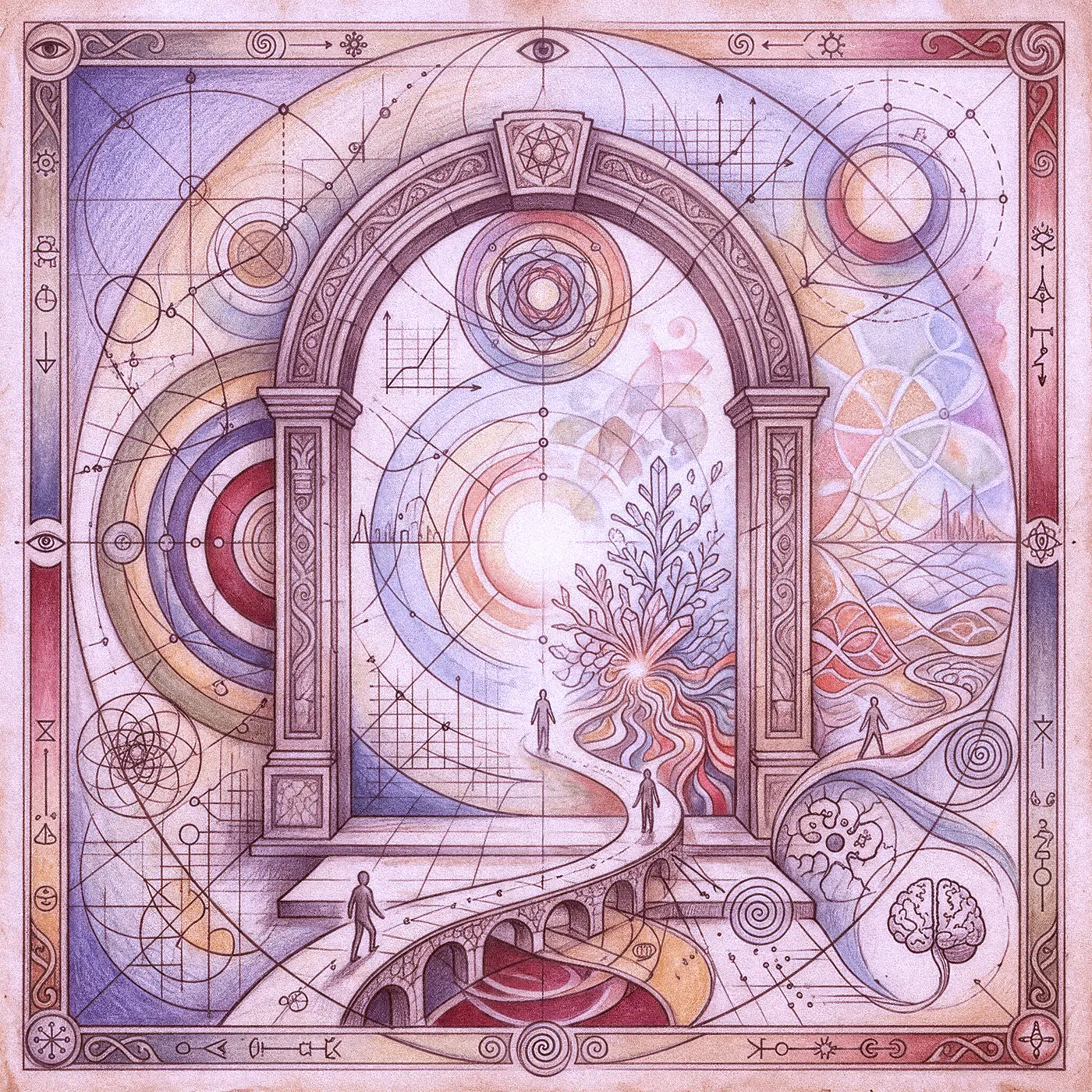
The Yogic Blueprint was created from this meeting point.
It is not a rejection of modern life. It is not asking you to give up success, comfort, pleasure, or ambition. It invites you to see clearly why none of these can complete the inner world by themselves. You do not have to become a monk to be spiritual, to meditate, or to access higher states of consciousness. The path begins where you are, in the life you are already living.
Through this foundational 7-day course, we investigate the nature of consciousness, the movement of the mind, emotional patterns, conditioning, energy, knowledge, and meditation. Each chapter is designed to help you see the inner mechanism more clearly, not as belief, but through direct observation.
With Mind-Yoga, you will learn how to turn attention inward, understand the movements of thought and emotion, and cultivate a mind that is clear, steady, and deeply alive.