- Wanting what is pleasant
- Resisting what is unpleasant
- Judging what appears
- Reacting before seeing clearly
The Yogic Blueprint
Success, comfort, and pleasure have value, but they cannot complete the inner world. Explore why lasting fulfillment also requires self-knowledge and inner awareness.
Most of us encounter meditation as a practice: sit down, close your eyes, follow the guided meditation, and perhaps feel calmer for a while. But the yogic understanding of meditation points toward something much deeper. What if meditation is not something you practice in your app, but a fundamentally different way of experiencing life?
This is one of the central explorations of Mind-Yoga. Rather than simply trying to calm the mind through external tools, we begin to understand the mind itself.
Let us investigate together.
In today’s world, meditation is becoming increasingly popular, yet only a few discover what it truly means to be meditative. A commercialized world turns everything into a product, and meditation is no exception. This means that mediation is more accessible than ever, but often at the cost of depth. It is commonly reduced to something we open for ten minutes, use to relax, and then put away.
There is nothing wrong with using meditation to reduce stress. Even a few quiet minutes can be valuable. But if meditation remains only a temporary escape from a busy mind, one may never discover what it actually means to become meditative.
To understand meditation from a deeper perspective, we need to step beyond the modern form and look toward the contemplative traditions that explored it for thousands of years.
A yogi sees meditation as a way of being.

Your meditation journey may begin as a practice through an app, but eventually the practice evolves toward a different way of experiencing life.
In yogic traditions, meditation is deeply revered. It is connected with the desire to know yourself, to understand life more fully, and to explore states of perception that ordinary consciousness never accesses.
Meditation invites you beyond the surface of thought. It asks what remains when the mind becomes quiet, when identity loosens its grip, and when attention is no longer constantly pulled outward. In meditative traditions, the highest aspiration of meditation is awakening. It is a direct realization of unity, or oneness, beyond the ordinary sense of separation.
This tells us something important from the beginning. Meditation is not something you do for five minutes and then call it a day. To access deeper states of meditation requires discipline, patience, and a willingness to keep looking within.
As with anything worthwhile in life, depth is cultivated over time.
And the fruit it bears is sweet.
True meditation fundamentally changes the way you understand yourself. It gives space to the mind, relaxes the nervous system and sharpens attention. Focus becomes more natural because the mind is no longer being dragged by every passing thought into distraction.
Meditation goes deeper than concentration or relaxation. A meditative mind meets life differently. It becomes less trapped in the constant movement of preference and judgment: “I want this.” “I dislike that.” “This should happen.” “That should not happen.”
Normally, the mind is continuously dividing experience according to its conditioning. It accepts what agrees with its preferences and resists what does not. Much of our psychological struggle is created within this movement.
Most people think their preferences are an expression of freedom. But in yoga, attachment to likes and dislikes is seen as one of the greatest obstacles to freedom. If your inner state is constantly determined by whether life gives you what you want or takes you toward what you dislike, then you are not truly free. You are being pushed and pulled by every movement of your own mind.
Meditation reveals this movement and unbinds you from it.
When the mind is ruled by attraction and resistance, life is constantly pulling it in opposite directions.
A yogi begins to see how unnecessary it is to attach meaning to everything that appears. Not every thought requires a conclusion. Not every emotion requires a reaction. Not every experience needs to become part of a personal story.
Letting go becomes the way.
You see, whatever can be observed is a phenomenon arising and passing within consciousness. Thoughts, emotions, sensations — they all move. Experiences come and go. Nothing remains exactly as it is.
The meditative mind therefore learns to see life without clinging. It becomes less driven by the constant need to acquire, control, resist, or become something else.
If you can observe desire without immediately obeying it, anger without becoming consumed by it, and fear without automatically believing it, your relationship with everyday life begins to change. In a way, you become a superhuman because you develop a degree of inner clarity and self-control that is surprisingly uncommon.
The ordinary mind is easily captured by thought, emotion, and impulse, while the meditative mind has space between experience and reaction. Thought can arise without becoming truth, emotion without becoming action, and desire without becoming command.
In that space, a deeper kind of freedom becomes possible.
Out of this fundamentally different way of being, new states of consciousness are accessed. Experienced meditators feel greater peace, joy, clarity, stillness, and a sense of openness that changes the way life is experienced. Over time, the mind itself begins to change. It becomes less mechanical, less reactive, and less bound by unconscious patterns.
This is why meditation and Mind-Yoga belong together. Meditation creates the space to observe, while Mind-Yoga helps us understand what is being observed. Together, they turn the mind from something that unconsciously controls you into something you can understand clearly.
One common misunderstanding is that meditation requires you to force the mind into silence. But this is not true. The mind begins to settle when its inner workings are seen clearly.
Through direct perception, you begin to notice thought, judgment, resistance, and emotion as they arise. As these movements become more conscious, they gradually lose their power to pull the mind in every direction.
This way of being is something that many people try to access through psychedelics. Psychedelics may have their place, but a temporary experience is not the same as cultivating a stable inner state. A yogi does not depend on external substances to touch a higher state. Nor is the yogi trying to escape ordinary life.

Inner freedom changes the way ordinary life is experienced. Even being bored can be a spiritual experience.
In Zen Buddhism, there is a well-known saying: “Before enlightenment, chop wood, carry water. After enlightenment, chop wood, carry water.”
From the outside, life may look almost exactly the same. Your work remains. Your responsibilities remain. The upcoming family reunion remains. What changes is your relationship with all of it.
These things no longer occupy the entire inner world or pull the mind in every direction. Life becomes simple because inwardly you are no longer carrying so much unnecessary resistance, fear, and psychological weight.
If you look within yourself or observe the world around you, you can easily see how much people struggle with simple everyday activities. Yet even an ant knows how to survive in this world. Surely, human beings can learn to move through their day with ease.
And once you do, your life will feel less like a burden and more like a playground and opportunity for greatness. This is perhaps one of the most important qualities of the meditative mind. It does not need to escape life in order to experience inner freedom. It learns to remain inwardly clear while participating fully in the world.

Have you ever felt that temporary calm is not enough? Do you wish to discover meditation as something deeper than relaxation, something that changes the very way you meet life?
Meditation becomes available when the mind starts to understand its own movement. Through this seeing, the mind begins to settle naturally, and life can be met without constant resistance, judgment, and escape.
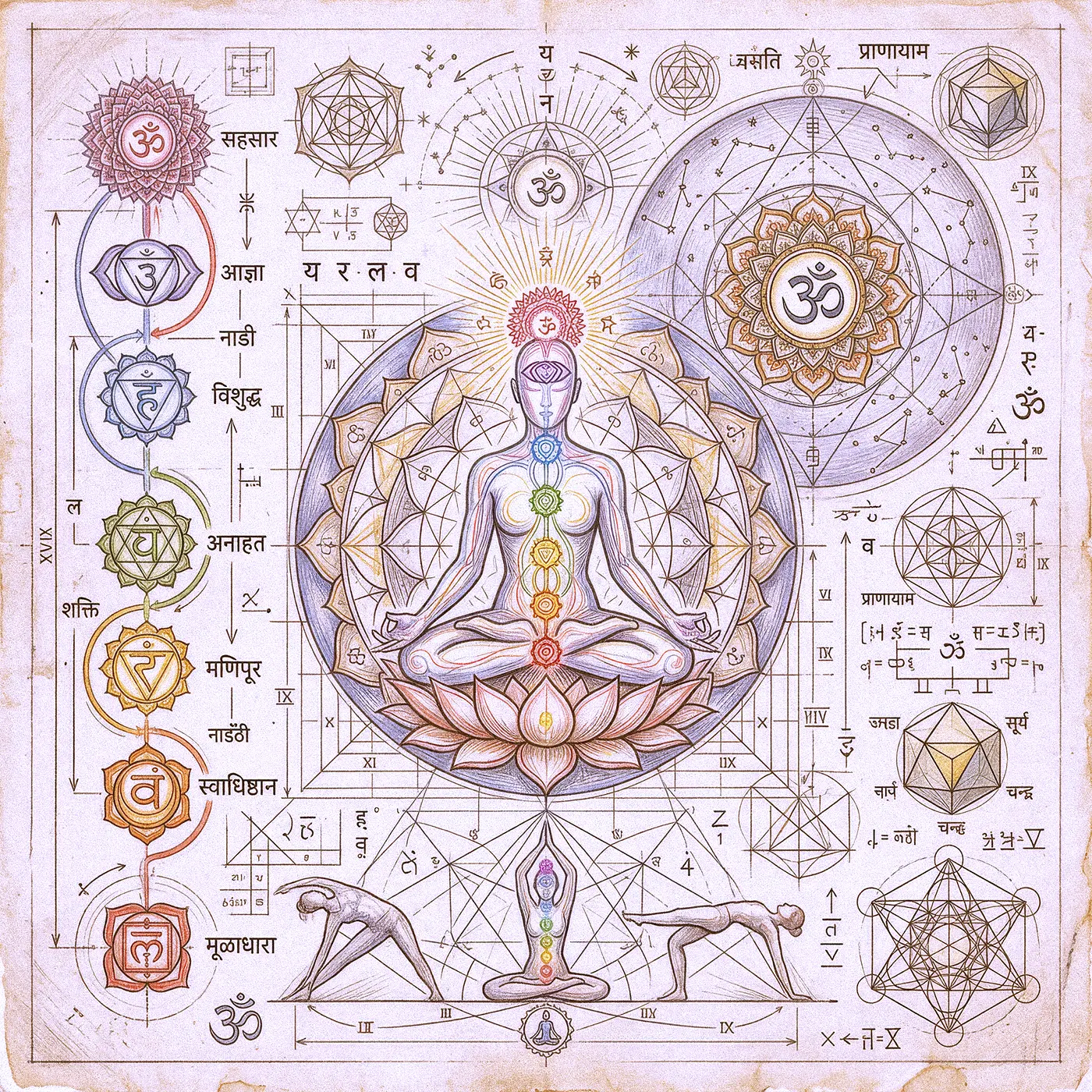
The Yogic Blueprint was created for those who sense that meditation is something sacred. Our course does not ask you to blindly believe in spiritual ideas. It invites you to observe your own mind, understand your patterns, and begin practicing meditation in a deeper way.
Across seven days, you are guided through consciousness, the nature of the mind, emotional patterns, conditioning, energy, knowledge, and meditation. Each chapter combines teaching, reflection, observation, and guided practice, so the wisdom does not remain abstract. It becomes something you can see directly within yourself.